 (+035) 527-1710-70
 NEWSLETTER

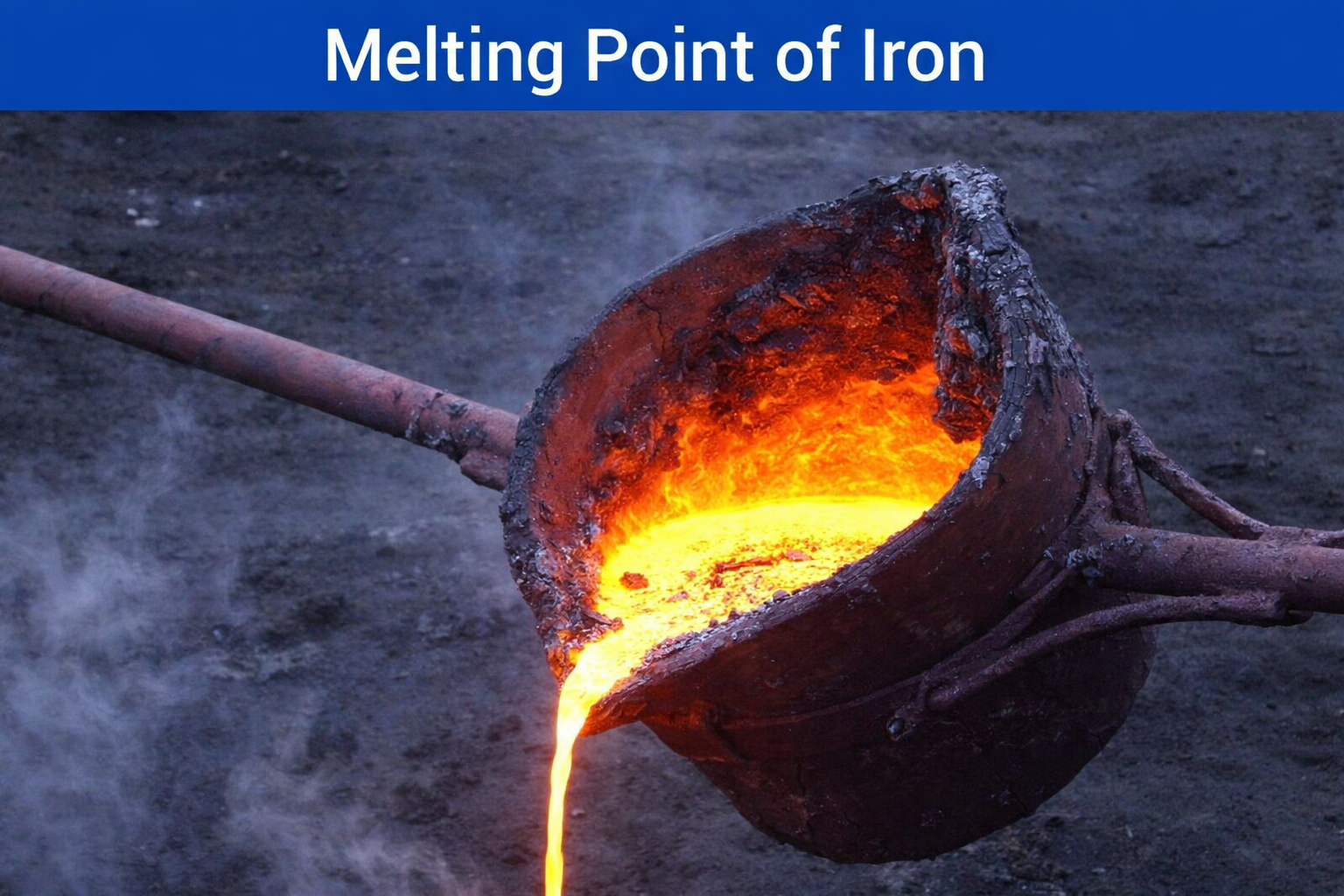
Iron is the backbone of modern industry. From structural beams and automotive engines to heavy machinery and aerospace components, iron and iron-based alloys support high-load, high-temperature, and high-performance environments.
One of the most critical properties governing iron’s performance is its melting point. Understanding the melting point of iron is essential for casting, forging, welding, alloy development, and high-temperature engineering design.
This comprehensive guide explains:
The exact melting and boiling points of iron
How atomic structure affects thermal behavior
How impurities and alloying elements change melting characteristics
Industrial applications across casting, steelmaking, and manufacturing
How engineers use this data for material selection
What Is the Melting Point of Iron?
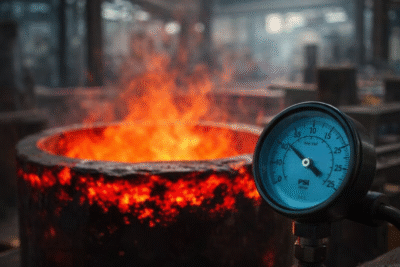
The melting point of pure iron is:
1,538°C (2,800°F)
At this temperature, iron transitions from a solid crystalline structure into a liquid state. This phase change requires significant thermal energy due to the strong metallic bonding between iron atoms.
Why Iron Has a High Melting Point
Iron’s high melting point is primarily due to:
Strong metallic bonds between atoms
Dense atomic packing
Stable crystalline structures
High cohesive energy
Compared to many commonly used metals, iron maintains structural integrity at elevated temperatures, making it suitable for demanding industrial environments.
Why the Melting Point of Iron Is Industrially Important
Understanding iron’s melting temperature is not just theoretical—it directly influences real-world manufacturing decisions.
1. Thermal Processing
Industrial processes such as:
Sand casting
Investment casting
Forging
Welding
Heat treatment
All depend on accurate knowledge of iron’s melting and solidification behavior.
If processing temperatures are miscalculated, defects such as:
Shrinkage cavities
Cracking
Incomplete mold filling
Grain structure irregularities
can occur.
2. Material Selection in High-Temperature Applications
Industries that rely on iron’s high melting point include:
Construction (structural steel frameworks)
Automotive (engine blocks, crankshafts)
Power generation (turbine housings)
Heavy equipment manufacturing
Industrial furnace systems
Iron’s resistance to softening under heat ensures dimensional stability and load-bearing performance.
3. Alloy Engineering and Solidification Control
Melting point data is critical when designing iron-based alloys such as:
Carbon steels
Cast irons
Stainless steels
Tool steels
Engineers adjust alloy composition to modify:
Melting range
Fluidity
Solidification rate
Microstructure formation
How Is Iron’s Melting Point Measured?
Accurate measurement of iron’s melting temperature is essential in metallurgy and quality control.
Differential Thermal Analysis (DTA)
DTA measures heat flow differences between an iron sample and a reference material.
When iron reaches its melting point:
It absorbs latent heat
Temperature temporarily stabilizes
A thermal peak appears on the analysis curve
Used in: Laboratory research, alloy development, material certification.
Thermocouples
Thermocouples operate based on the Seebeck effect. Two dissimilar metals generate voltage proportional to temperature changes.
They are commonly used in:
Steel mills
Foundries
Smelting operations
Industrial furnaces
Thermocouples provide real-time temperature monitoring in high-temperature environments.
Optical Pyrometry
Optical pyrometers measure temperature without physical contact by analyzing emitted thermal radiation.
Advantages:
Safe measurement above 1,500°C
Ideal for molten metal
Used in steelmaking and aerospace manufacturing
How Iron’s Atomic Structure Affects Its Melting Point
Iron’s melting behavior is closely related to its crystal structure and atomic bonding.
Allotropic Forms of Iron
Iron undergoes phase transformations before melting:
Alpha Iron (α-iron) – Body-Centered Cubic (BCC), stable at room temperature
Gamma Iron (γ-iron) – Face-Centered Cubic (FCC), forms at ~912°C
Delta Iron (δ-iron) – BCC structure near melting point
These structural transitions affect density, atomic packing efficiency, and thermal stability.
Electron Configuration and Bond Strength
Iron’s electron configuration:
[Ar] 3d⁶ 4s²
The partially filled d-orbitals enable strong metallic bonding, requiring substantial energy to disrupt—resulting in a high melting temperature.
Influence of Iron Ore and Impurities on Melting Behavior
Iron is extracted primarily from:
Hematite (Fe₂O₃)
Magnetite (Fe₃O₄)
During smelting, impurities affect final melting characteristics.
Common Impurities
Sulfur
Causes hot shortness
Increases brittleness
Phosphorus
Improves fluidity
Reduces ductility
Silicon
Lowers melting temperature
Improves castability
Controlled refining ensures consistent melting behavior and thermal performance.
Melting Point Comparison: Iron vs Other Metals
| Metal | Melting Point (°C) | Industrial Implication |
| Iron | 1,538°C | Strong, heat-resistant structural metal |
| Aluminum | 660°C | Lightweight but low heat tolerance |
| Copper | 1,085°C | Conductive but melts earlier than iron |
| Carbon Steel | 1,370–1,510°C | Depends on carbon content |
| Gold | 1,064°C | Easily refined and shaped |
| Lead | 327°C | Very low structural strength |
| Tungsten | 3,422°C | Extreme high-temperature applications |
Industrial Interpretation
Iron is ideal for high-temperature structural components.
Aluminum is preferred for lightweight applications.
Copper excels in electrical conductivity.
Tungsten is used in extreme aerospace and high-temperature tooling.
Different Types of Iron and Their Melting Points
Cast Iron
Carbon content: 2–4%
Melting range: 1,150°C – 1,300°C
Higher carbon lowers melting temperature and improves fluidity.
Applications:
Engine blocks
Pump housings
Pipes
Industrial cookware
Wrought Iron
Carbon content: 0.05–0.15%
Melting point: Close to pure iron
Properties:
High ductility
Corrosion resistance
Malleability
Pig Iron
Carbon content: 3.5–4.5%
Intermediate product in steelmaking
Brittle and rarely used directly in structural applications.
Boiling Point of Iron
The boiling point of iron is:
2,862°C (5,204°F)
At this temperature, iron transitions from liquid to vapor.
This requires enormous energy input and is typically observed only in:
Advanced laboratory settings
Aerospace material research
High-energy industrial environments
What Happens at Iron’s Melting and Boiling Points?
At Melting Point
Crystal lattice collapses
Solid becomes liquid
Atomic mobility increases
Enables casting and alloying
At Boiling Point
Atoms gain sufficient energy to escape liquid phase
Iron vapor forms
Used in thin film deposition and specialized coating technologies
Industrial Relevance of Iron’s Thermal Properties
Iron’s melting and boiling behavior directly support:
1. Precision Casting
Controlled pouring temperatures
Defect prevention
Improved mechanical properties
2. Forging and Welding
Accurate heat input
Grain refinement
Structural integrity
3. Alloy Customization
Adjusting melting range
Enhancing strength
Improving corrosion resistance
4. High-Temperature Performance
Industrial furnaces
Structural frameworks
Power generation systems
Heavy-duty machinery
Why Understanding Iron’s Melting Point Matters for Your Project
If you are sourcing iron castings, forged components, or custom alloy parts, understanding melting behavior ensures:
Optimal manufacturing temperature control
Reduced defect rates
Improved product durability
Compliance with engineering standards
Cost-effective material selection
Selecting the correct iron grade and processing method directly impacts product lifespan and reliability.
Conclusion
The melting point of iron—1,538°C—is fundamental to its role in modern industry. Its strong metallic bonding, stable crystal structures, and high thermal resistance make it indispensable in construction, automotive engineering, heavy machinery, and aerospace systems.
By understanding iron’s atomic structure, impurity effects, alloy variations, and thermal transitions, engineers and manufacturers can design safer, stronger, and more efficient components.
If your project requires precision iron castings, high-temperature steel components, or customized alloy solutions, working with an experienced manufacturing partner ensures consistent quality and controlled thermal processing.
Contact us to discuss your specifications, technical drawings, or material requirements—we’re ready to support your next high-performance metal project.
FAQs
1. What is the melting point of pure iron?
Approximately 1,538°C (2,800°F).
2. Can alloying change iron’s melting point?
Yes. Carbon, silicon, nickel, and chromium can alter melting range and solidification behavior.
3. Why does cast iron melt at a lower temperature?
Higher carbon content lowers melting temperature and improves fluidity.
4. Is iron suitable for high-temperature applications?
Yes. Its high melting point makes it suitable for structural and thermal applications.
5. What is iron’s boiling point?
Approximately 2,862°C (5,204°F).
6. How does iron compare to aluminum in heat resistance?
Iron withstands significantly higher temperatures than aluminum, making it better for heat-intensive environments.